Posts

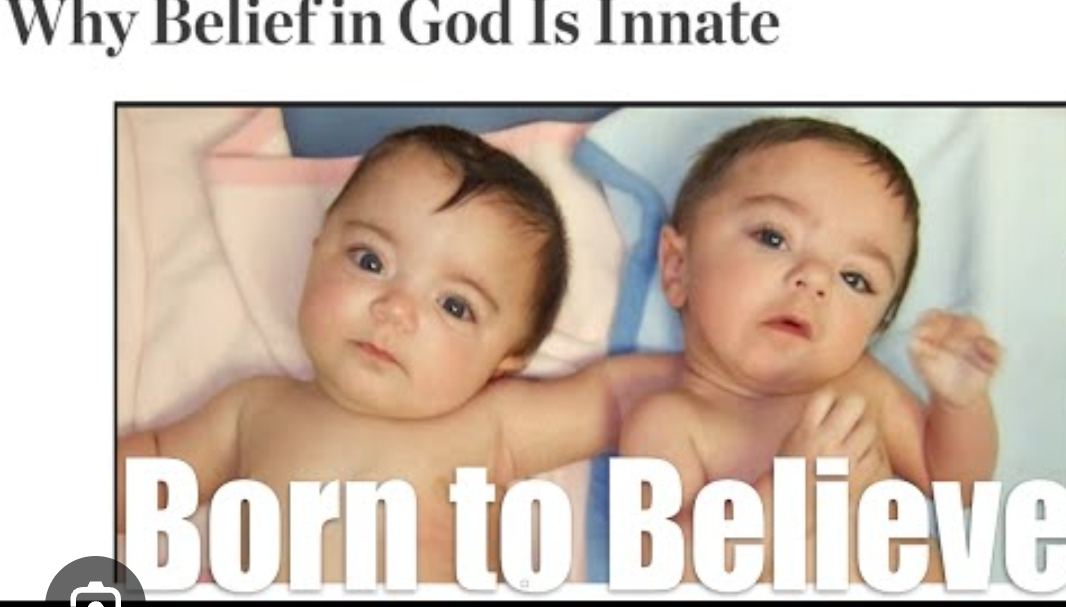
The Naturalness of Believing in Gods: Why Children Hold the Key to Understanding Religious Belief
Image
Romans 1:20 “For since the creation of the world His invisible attributes, His eternal power and divine nature, have been clearly seen, being understood through what has been made.” Matthew 18:3 “And said, "Truly I say to you, unless you are converted and become like children, you will not enter the kingdom of heaven.” The pervasiveness of religious belief across cultures and throughout history is a fascinating phenomenon. Why do the majority of people believe in gods? While the answer may seem straightforward – that children are indoctrinated by their parents and communities – recent research suggests a more nuanced explanation. By exploring the cognitive tendencies of children, we can gain valuable insights into the widespread appeal of religious ideas. Children's Innate Predisposition to See Purpose and Design Children possess a natural inclination to perceive the world around them as purposeful and designed. They tend to see intentionality behind natural events...

"Can you bind the chains of the Pleiades, Or loose the cords of Orion?" (Job 38:31)

Image
Pleiades Orion's belt "Can you bind the chains of the Pleiades, Or loose the cords of Orion?" (Job 38:31 ) Scientific Observations: Pleiades: the Pleiades are a gravitationally bound star cluster. The stars are held together by their mutual gravity, making them appear as a tight group in the night sky. Orion: The stars in Orion's belt do indeed move apart over time, although this movement is extremely slow and wouldn't be noticeable to the naked eye. The "cords" mentioned in the verse could be a poetic way to describe this gradual dispersal. Connecting Science and Scripture: It's fascinating how this ancient text reflects an awareness of astronomical phenomena that we now understand through modern science. While the writer of Job likely didn't have the same scientific understanding as we do today, they clearly observed the patterns and movements of the stars. However they would not know or see these gravitational actions...

Transgenerational Trauma in the Black Church: The Role of Epigenetics

Image
Philemon  Plea to free Onesimus “I appeal to you for my child Onesimus, whom I have begotten in my imprisonment.” The Black Church in America has long been a central institution within the African American community, providing spiritual guidance, social support, and a refuge from the persistent realities of racism and discrimination. However, the historical and ongoing trauma experienced by Black Americans has left an indelible mark, not just on individuals, but on the collective memory and even the genetic makeup of the community. This article explores the concept of transgenerational trauma within the context of the Black Church, examining how epigenetic mechanisms play a role in transmitting the effects of trauma across generations. Understanding Transgenerational Trauma Transgenerational trauma refers to the transmission of the psychological and emotional impact of traumatic experiences from one generation to the next. This transmission can occur through various cha...

The BGV Theorem and its Significance

Image
The BGV Theorem and its Significance: Expanding Universe: The BGV theorem focuses on universes that are expanding, like ours. This expansion is a key observation in cosmology, supported by evidence like the redshift of distant galaxies. Past-Incomplete: The theorem demonstrates that any expanding universe, under certain conditions, cannot be infinitely old. It must have a boundary or a beginning in the past. This challenges the idea of a "past-eternal" universe that has always existed. Special Relativity: Interestingly, the theorem's proof relies on the principles of special relativity (like the constancy of the speed of light and the relativity of time), rather than the more complex general relativity (which deals with gravity). Vilenkin's Interpretation: Alexander Vilenkin, one of the authors of the BGV theorem, argues that the theorem effectively eliminates the possibility of a past-eternal universe. This forces cosmologists to confront the idea of a...

Theistic Evolution's Subtle Veil: How God's Creative Act is Obscured

Image
Theistic evolution, also known as evolutionary creation, attempts to reconcile religious belief with the scientific consensus on evolution. It posits that God initiated or guided the evolutionary process, allowing life to develop and diversify over billions of years. This perspective seeks a harmonious coexistence between faith and reason, but in its attempt to bridge the divide, theistic evolution can inadvertently obscure the grandeur of God's creative act. This essay will explore the nuanced ways in which the gentle nudge of theistic evolution can hide the awe-inspiring nature of God's creation. A Gradual Unveiling: Theistic evolution portrays the emergence of life as a gradual, incremental process. Over eons, simple organisms evolved into complex beings, culminating in the existence of humanity. This gradual unfolding can subtly diminish the perception of divine creation. Instead of a dramatic act of divine will, life appears to materialize through a series of n...

What would be the best way to politely decline a persistent Jehovah's Witness at your door?

Image
I was in med school when a JW lady knocked on my door. She said she had a book from her order and said it cost a quarter. I asked her: “Is your religion for sale?” , to which she was taken aback: “Oh, no!” , she said. She shared some stuff while holding onto a Bible . I asked if she believed in the Bible and she said, “Oh, yes!” .I then said: “Some other religious folks had come by, and brought this” , I produced a Four Spiritual Laws booklet. I asked about John 3:16 in the book: “Is this in the Bible?” .She turned to it. There it was: “For God so loved the world that he gave his one and only Son, that whoever believes in him shall not perish but have eternal life” . I asked: “Is this true?” , “Oh no!” , she exclaimed. What about this: “All have sinned and fall short of the glory of God” (Romans 3:23). There it was in the Bible. Is this true? “Oh no!” she again said. “God demonstrates His own love toward us, in that while we were yet sinners, Christ died for us” (Roman...

Quantum Mechanics in Job 38:35: The Divine Observer

Image
Job 38:35, amidst a poetic discourse on God's power over nature, subtly resonates with concepts central to quantum mechanics. The verse inquires, "Can you send forth lightning that they may go And say to you, 'Here we are'?" This seemingly simple question, when examined through the lens of quantum physics, reveals profound implications about the nature of reality and the role of an ultimate observer - God. The Quantum Nature of Lightning Lightning, at its core, is a manifestation of the behavior of photons, the fundamental particles of light. Quantum mechanics describes light as possessing a dual nature - existing as both waves and particles. This wave-particle duality is a cornerstone of quantum theory and challenges our classical understanding of reality. When the verse speaks of sending forth lightnings, it evokes the idea of photons being emitted or released. The phrase "say to you, 'Here we are'" can be interpreted as an acknowle...